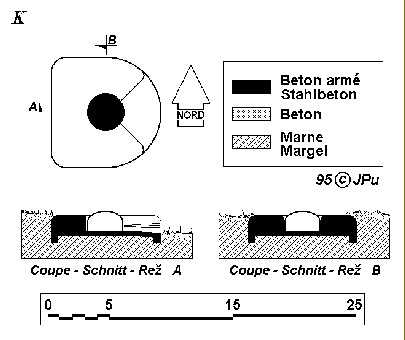
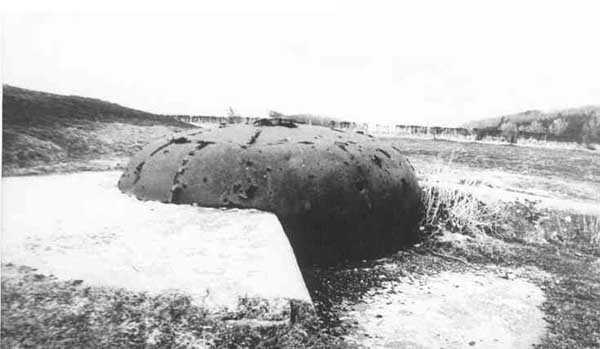
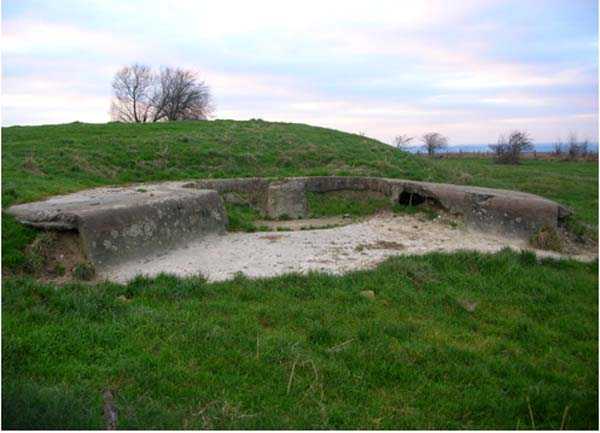
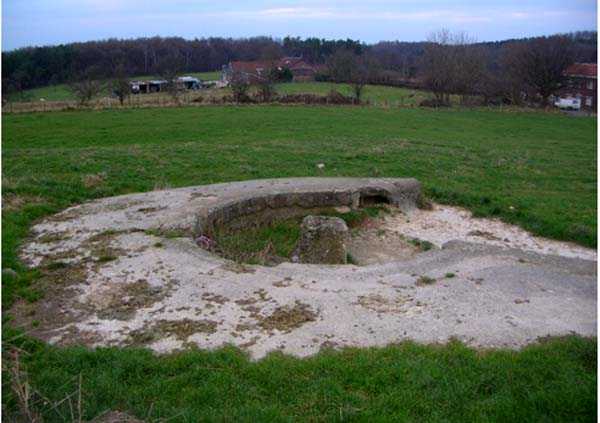
Fortification belge de la deuxième guerre mondiale, position fortifiée de Liège, première ligne de résistance, fort d'Aubin-Neufchâteau. Je n'ai pas pu retrouver de photos d'archive au sujet du bloc K. Il a pourtant eu son utilité stratégique et tactique. Il s'agissait d'un petit bloc sans fondations équipé d'une cloche en tôle, copie exacte des cloches pour mitrailleuses lourdes. Ce bloc ne possédait ni locaux ni armement. Il n'y avait donc pas de communication avec le fort. Toutefois, une ébauche de galerie, fermée par une porte blindée existe dans les substructions du bloc B1. Au cours des combats, le bloc K a été attaqué au fusil, à la mitrailleuse et au canon léger. Sa cloche est percée par de très nombreux impacts. L'ennemi y a donc gaspillé une importante quantité de munitions. Il est probable que le fort ait répondu par une salve de bombes de mortier à chaque attaque du bloc K pour maintenir aussi longtemps que possible son effet purement dissuasif. Fort abîmée, elle termine sa vie sur le devant du bloc d'entrée. Le plan du bloc présente peu d'intérêt mais je le publie quand même. Il va de soi qu'aucun homme n'était affecté à ce bloc fantôme et que seuls quelques initiés savaient qu'il n'y avait pas de galerie derrière la porte blindée tout comme très peu d'initiés avaient connaissance d'une issue de secours au bloc observatoire O. D'ailleurs à ce titre le Mdl Mathieu Nibus, ancien du fort, m'a soutenu jusqu'à son dernier souffle que cette issue n'existait pas alors que c'est par là que nous sommes entrés dans le BO. Mais ça c'est une autre histoire. Toujours est-il que les pionniers allemands ont gaspillé des centaines, si pas des milliers, de cartouches pour ne rien obtenir d'autre que des centaines de trous dans de la tôle de 2 mm d'épaisseur.
Belgische Befestigung des Zweiten Weltkriegs, befestigte Stellung Lüttich, erste Widerstandslinie, Fort Aubin-Neufchâteau. Ich habe keine Archivfotos über Block K finden können. Er hatte jedoch seinen strategischen und taktischen Nutzen. Es handelte sich um einen kleinen Block ohne Fundamente, ausgerüstet mit einer Blechkuppel, exakte Kopie der Kuppeln für schwere Maschinengewehre. Dieser Block besaß weder Räume noch Bewaffnung. Es gab also keine Verbindung mit dem Fort. Allerdings existiert ein Galerieanfang, verschlossen durch eine Panzertür, in den Unterbauten von Block B1. Während der Kämpfe wurde Block K mit Gewehr, Maschinengewehr und leichtem Geschütz angegriffen. Seine Kuppel ist von sehr zahlreichen Einschlägen durchbohrt. Der Feind hat dort also eine bedeutende Menge Munition verschwendet. Es ist wahrscheinlich, dass das Fort mit einem Salvenfeuer von Mörsergranaten auf jeden Angriff auf Block K reagiert hat, um seine rein abschreckende Wirkung so lange wie möglich aufrechtzuerhalten. Stark beschädigt, beendet sie ihr Leben vor dem Eingangsblock. Der Plan des Blocks ist von geringem Interesse, aber ich veröffentliche ihn trotzdem. Es versteht sich, dass kein Mann diesem Phantomblock zugeteilt war und dass nur einige Eingeweihte wussten, dass es keine Galerie hinter der Panzertür gab, genauso wie sehr wenige Eingeweihte von einem Notausgang am Beobachtungsblock O Kenntnis hatten. Übrigens hat in dieser Hinsicht der Hptm Mathieu Nibus, ehemaliger Angehöriger des Forts, mir bis zu seinem letzten Atemzug versichert, dass dieser Ausgang nicht existierte, während wir genau dort in den BO eingestiegen sind. Aber das ist eine andere Geschichte. Jedenfalls haben die deutschen Pioniere Hunderte, wenn nicht Tausende, von Patronen verschwendet, um nichts anderes zu erzielen als Hunderte von Löchern in 2 mm dickem Blech.
Belgische fortificatie van de Tweede Wereldoorlog, versterkte stelling Luik, eerste weerstandslijn, fort Aubin-Neufchâteau. Ik heb geen archieffoto's kunnen terugvinden over blok K. Het had echter zijn strategisch en tactisch nut. Het ging om een klein blok zonder funderingen uitgerust met een koepel in plaatijzer, exacte kopie van de koepels voor zware mitrailleurs. Dit blok bezat noch lokalen noch bewapening. Er was dus geen communicatie met het fort. Nochtans bestaat een schets van een galerij, afgesloten door een pantserdeur, in de onderbouw van blok B1. Tijdens de gevechten werd blok K aangevallen met geweer, mitrailleur en licht kanon. Zijn koepel is doorboord door zeer talrijke inslagen. De vijand heeft daar dus een belangrijke hoeveelheid munitie verspild. Het is waarschijnlijk dat het fort met een salvo mortierbommen op elke aanval op blok K heeft gereageerd om zijn louter afschrikkend effect zo lang mogelijk te handhaven. Zwaar beschadigd, beëindigt ze haar leven voor het ingangsblok. Het plan van het blok heeft weinig belang maar ik publiceer het toch. Het spreekt vanzelf dat geen man aan dit fantoomblok was toegewezen en dat slechts enkele ingewijden wisten dat er geen galerij achter de pantserdeur was, net zoals zeer weinig ingewijden kennis hadden van een nooduitgang bij het observatieblok O. Trouwens in dit opzicht heeft de Mdl Mathieu Nibus, oudgediende van het fort, mij tot zijn laatste ademtocht verzekerd dat deze uitgang niet bestond terwijl we daar precies in de BO zijn binnengegaan. Maar dat is een ander verhaal. Hoe dan ook hebben de Duitse pioniers honderden, zo niet duizenden, patronen verspild om niets anders te bereiken dan honderden gaten in 2 mm dik plaatijzer.
Belgian fortification of the Second World War, fortified position of Liège, first line of resistance, fort of Aubin-Neufchâteau. I have not been able to find any archive photos concerning block K. However, it had its strategic and tactical utility. It was a small block without foundations equipped with a sheet metal cupola, exact copy of the cupolas for heavy machine guns. This block had neither rooms nor armament. There was therefore no communication with the fort. However, a draft of a gallery, closed by an armored door, exists in the substructures of block B1. During the fighting, block K was attacked with rifle, machine gun and light gun. Its cupola is pierced by very numerous impacts. The enemy therefore wasted a significant quantity of ammunition there. It is probable that the fort responded with a salvo of mortar bombs to each attack on block K to maintain as long as possible its purely deterrent effect. Badly damaged, it ends its life in front of the entrance block. The plan of the block is of little interest but I publish it anyway. It goes without saying that no man was assigned to this phantom block and that only a few initiates knew that there was no gallery behind the armored door, just as very few initiates were aware of an emergency exit at the observation block O. Moreover, in this regard, Sgt Mathieu Nibus, former member of the fort, assured me until his last breath that this exit did not exist whereas it is through there that we entered the OB. But that's another story. The fact remains that the German pioneers wasted hundreds, if not thousands, of cartridges to obtain nothing other than hundreds of holes in 2 mm thick sheet metal.
Belgické opevnění z druhé světové války, opevněná pozice Lutychu, první obranná linie, tvrz Aubin-Neufchâteau. Nepodařilo se mi najít žádné archivní fotografie týkající se objektu K. Přesto měl svůj strategický a taktický význam. Šlo o malý objekt bez základů vybavený plechovou kopulí, přesnou kopii zvonů pro těžké kulomety. Tento objekt neměl ani místnosti, ani výzbroj. Nebyla tedy žádná komunikace s tvrzí. Nicméně v podzemí objektu B1 existuje náčrt galerie uzavřený pancéřovými dveřmi. Během bojů byl objekt K napaden puškami, kulomety a lehkým dělem. Jeho kopule je proražena velmi četnými zásahy. Nepřítel tam tedy promarnil značné množství munice. Je pravděpodobné, že tvrz odpověděla salvou minometných min na každý útok na objekt K, aby udržela co nejdéle svůj čistě odstrašující účinek. Těžce poškozená končí svůj život před vchodovým objektem. Plán objektu má malý význam, ale přesto jej zveřejňuji. Samozřejmě, že žádný muž nebyl přidělen tomuto fantomovému objektu a jen několik zasvěcených vědělo, že za pancéřovými dveřmi není žádná galerie, stejně jako velmi málo zasvěcených vědělo o nouzovém východu u pozorovacího objektu O. Mimochodem, v této souvislosti mě desátník Mathieu Nibus, bývalý příslušník tvrze, ujišťoval až do svého posledního dechu, že tento východ neexistuje, zatímco právě tam jsme vstoupili do PO. Ale to je jiný příběh. Každopádně němečtí pionýři promarnili stovky, ne-li tisíce, nábojů, aby nedosáhli nic jiného než stovky děr v 2 mm silném plechu.
