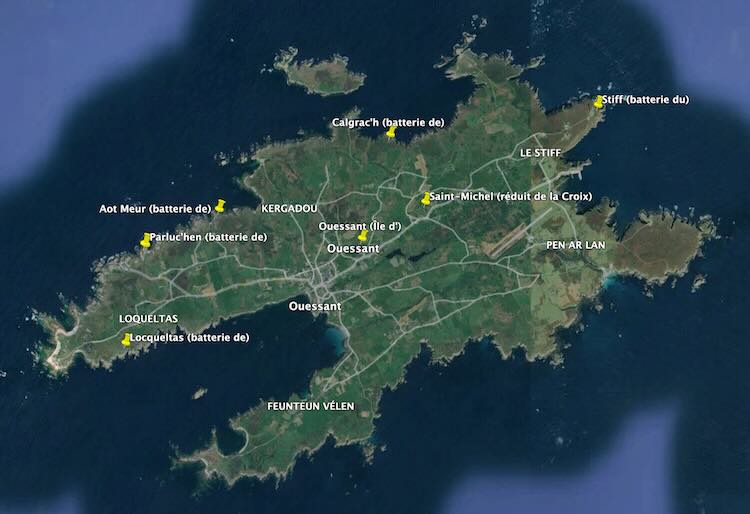
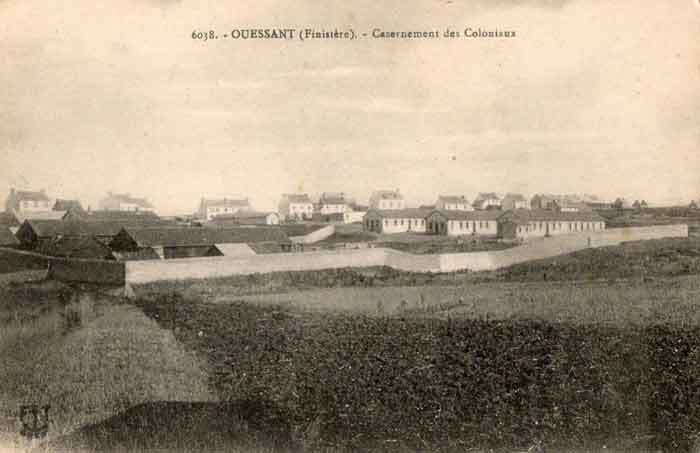
Dept 29 (Finistère). Cette île est la grand'garde de la rade de Brest et son occupation est essentielle. Quatre positions sont à retenir sur cette île splendide et sauvage, soit le réduit de la Croix Saint-Michel ainsi que les batteries du Stiff, de Calgrach et de Locqueltas. Vers 1899, on envisagea la possibilité de doter l'île de deux batteries de très gros calibre sous tourelles blindées pour tenir les navires à distance. Ainsi on prévoyait la construction d'un réduit central et d'un môle entre Youc'h Korz et la côte nord de la baie de Lampaul. Or, outre les crédits nécessaires, c'est paradoxalement la crainte d'un bombardement tous azimuts qui amena au renoncement de ce qui eut pu devenir une seconde Helgoland. À la veille de la construction du fort Saint-Michel, l'île abritait deux compagnies d'infanterie coloniale qui disposait de 6 x 65 mm modèle 1881, 8 x 37 mm tir rapide, le tout sur affûts de débarquement, et 8 x 95 mm sur affûts de campagne. Peu avant la première guerre mondiale, on prévoyait, en cas de conflit de défendre l'île avec deux compagnies de territoriaux soutenues par 3 sections de mitrailleuses.
Dept 29 (Finistère). Diese Insel ist die Vorpostenstellung der Reede von Brest und ihre Besetzung ist wesentlich. Vier Stellungen sind auf dieser prächtigen und wilden Insel zu erwähnen, nämlich das Reduit Croix Saint-Michel sowie die Batterien Stiff, Calgrach und Locqueltas. Um 1899 erwog man die Möglichkeit, die Insel mit zwei Batterien sehr großen Kalibers unter Panzertürmen auszustatten, um Schiffe auf Distanz zu halten. So war der Bau eines Zentralreduits und eines Molens zwischen Youc'h Korz und der Nordküste der Bucht von Lampaul geplant. Doch abgesehen von den erforderlichen Mitteln war es paradoxerweise die Furcht vor einem allseitigen Bombardement, die zum Verzicht auf das führte, was ein zweites Helgoland hätte werden können. Vor der Errichtung des Forts Saint-Michel beherbergte die Insel zwei Kompanien Kolonialinfanterie, die über 6 x 65 mm Modell 1881, 8 x 37 mm Schnellfeuer, alles auf Landungslafetten, und 8 x 95 mm auf Feldlafetten verfügten. Kurz vor dem Ersten Weltkrieg plante man, die Insel im Konfliktfall mit zwei Kompanien Territorialinfanterie, unterstützt von 3 Maschinengewehr-Zügen, zu verteidigen.
Dept 29 (Finistère). Dit eiland is de voorpost van de rede van Brest en zijn bezetting is essentieel. Vier posities zijn te onthouden op dit prachtige en wilde eiland, namelijk het reduit Croix Saint-Michel en de batterijen Stiff, Calgrach en Locqueltas. Rond 1899 overwoog men de mogelijkheid het eiland uit te rusten met twee batterijen van zeer groot kaliber onder gepantserde koepels om schepen op afstand te houden. Zo voorzag men de bouw van een centraal reduit en een golfbreker tussen Youc'h Korz en de noordkust van de baai van Lampaul. Maar behalve de nodige kredieten was het paradoxaal genoeg de vrees voor een bombardement vanuit alle hoeken die leidde tot het afzien van wat een tweede Helgoland had kunnen worden. Aan de vooravond van de bouw van fort Saint-Michel huisvestte het eiland twee compagnieën koloniale infanterie die beschikten over 6 x 65 mm model 1881, 8 x 37 mm snelvuur, alles op landingsaffuiten, en 8 x 95 mm op veldaffuiten. Kort voor de Eerste Wereldoorlog voorzag men, in geval van conflict, het eiland te verdedigen met twee compagnieën territorialen ondersteund door 3 mitrailleursecties.
Dept 29 (Finistère). This island is the outpost of the roadstead of Brest and its occupation is essential. Four positions are noteworthy on this splendid and wild island, namely the Croix Saint-Michel redoubt as well as the Stiff, Calgrach and Locqueltas batteries. Around 1899, the possibility of equipping the island with two batteries of very large caliber under armored turrets to keep ships at a distance was considered. Thus, the construction of a central redoubt and a mole between Youc'h Korz and the north coast of Lampaul Bay was planned. However, besides the necessary funds, it was paradoxically the fear of an all-round bombardment that led to the abandonment of what could have become a second Heligoland. On the eve of the construction of Fort Saint-Michel, the island housed two companies of colonial infantry which had 6 x 65 mm model 1881, 8 x 37 mm quick fire, all on landing carriages, and 8 x 95 mm on field carriages. Shortly before the First World War, it was planned, in case of conflict, to defend the island with two companies of territorials supported by 3 machine gun sections.
Dept 29 (Finistère). Tento ostrov je přední stráží rejdy Brest a jeho obsazení je nezbytné. Na tomto nádherném a divokém ostrově jsou třeba zmínit čtyři postavení, a to reduit Croix Saint-Michel a baterie Stiff, Calgrach a Locqueltas. Kolem roku 1899 se zvažovala možnost vybavit ostrov dvěma bateriemi velmi velké ráže pod pancéřovými věžemi, aby udržely lodě v patřičné vzdálenosti. Plánovala se tak výstavba centrálního reduitu a mola mezi Youc'h Korz a severním pobřežím zátoky Lampaul. Avšak kromě potřebných prostředků paradoxně obava z bombardování ze všech stran vedla k upuštění od toho, co se mohlo stát druhým Helgolandem. Před výstavbou fortu Saint-Michel ostrov hostil dvě roty koloniální pěchoty, které disponovaly 6 x 65 mm model 1881, 8 x 37 mm rychlopalnými děly, vše na vyloďovacích lafetách, a 8 x 95 mm na polních lafetách. Krátce před první světovou válkou se plánovalo v případě konfliktu bránit ostrov dvěma rotami teritoriálů podporovanými 3 kulometnými četami.
Cité dans : Zitiert in : Geciteerd in: Cited in: Citováno v: Aot Meur (batterie de), Stiff (batterie du), Central (fort)
