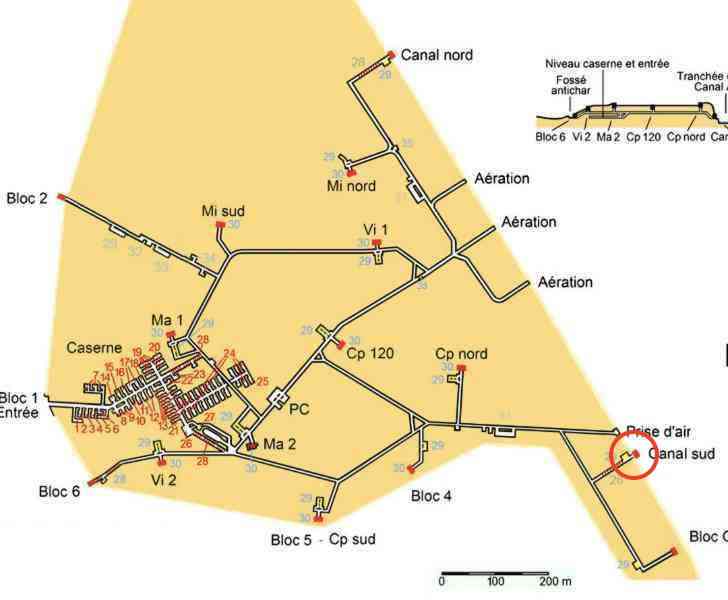
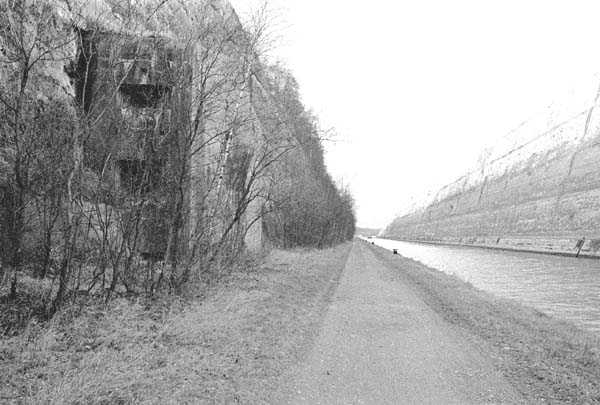
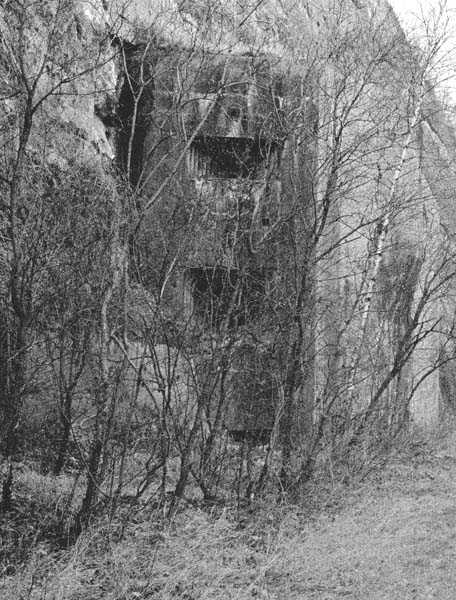

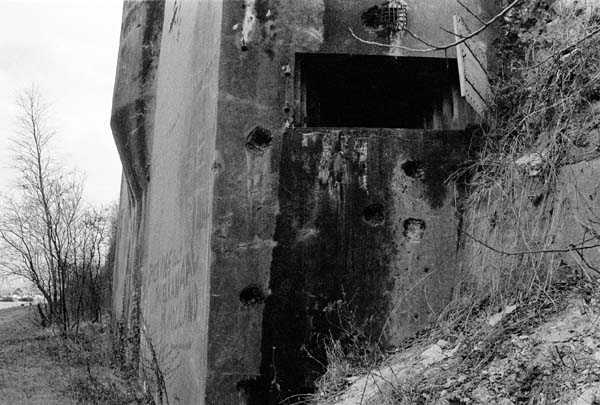
Fortifications belges de la seconde guerre mondiale, première ligne de défenses de Liège, position fortifiée de Liège, fort d'Eben-Emael, Canal Sud et Canal Nord étaient deux blocs jumeaux d'escarpe. Canal Sud a été démoli lors de l'élargissement du canal Albert en 1972 afin de permettre le passage de péniches de plus gros gabarit que 13 000 tonnes. Le but du bloc était d'assurer la protection de l'escarpe Est de l'ouvrage et de participer à l'interdiction du franchissement du canal Albert à hauteur de l'écluse de Lanaye. Canal Sud comportait quatre niveaux avec tout en bas, au niveau du chemin de halage, les projecteurs, les caves à douilles, les toilettes et l'issue de secours qui débouchait sur le chemin de halage ; au niveau 1, les chambres de tir pour canons de 60 mm ; au niveau 2, les chambres pour les mitrailleuses et l'accès à la cloche de guet ; en toiture, la petite cloche de guet. La galerie d'accès à Canal Sud est commune au bloc O1. Ce bloc ne fait pas non plus partie de la visite guidée mais il est maintenant possible de réserver des visites spéciales.
Belgische Befestigungen des Zweiten Weltkriegs, erste Linie der befestigten Stellung Lüttich, befestigte Stellung Lüttich, Fort von Eben-Emael, Canal Sud und Canal Nord waren zwei Eskarp-Zwillingsblöcke. Canal Sud wurde 1972 beim Ausbau des Albert-Kanals abgerissen, um die Durchfahrt von Schiffen mit mehr als 13 000 Tonnen zu ermöglichen. Die Aufgabe des Blocks war der Schutz der Ost-Eskarpie des Werks und die Beteiligung an der Sperrung der Albert-Kanal-Überquerung auf Höhe der Schleuse Lanaye. Canal Sud wies vier Ebenen auf: ganz unten, auf der Höhe des Treidelpfads, die Scheinwerfer, die Patronenkeller, die Toiletten und den Notausgang, der auf den Treidelpfad mündete; auf Ebene 1 die Schießkammern für 6-cm-Kanonen; auf Ebene 2 die Kammern für die Maschinengewehre und den Zugang zur Beobachtungsglocke (ZP); auf dem Dach die kleine Beobachtungsglocke (ZP). Der Zugangsgang zu Canal Sud ist mit Block O1 gemeinsam. Dieser Block ist ebenfalls nicht Teil der Führung, aber es ist jetzt möglich, Sonderführungen zu buchen.
Belgische versterkingen van de Tweede Wereldoorlog, eerste linie van de versterkte stelling Luik, versterkte stelling Luik, fort van Eben-Emael, Canal Sud en Canal Nord waren twee escarp-tweelingblokken. Canal Sud is in 1972 gesloopt tijdens de verbreding van het Albertkanaal om de doorgang van schepen met meer dan 13 000 ton mogelijk te maken. Het doel van de blok was de bescherming van de oostelijke escarpe van het werk en deel te nemen aan het verhinderen van de oversteek van het Albertkanaal ter hoogte van de sluis van Lanaye. Canal Sud telde vier niveaus: helemaal onderaan, op het niveau van het jaagpad, de zoeklichten, de patroonkelders, de toiletten en de nooduitgang die uitkwam op het jaagpad; op niveau 1 de schietkamers voor 6 cm kanonnen; op niveau 2 de kamers voor de machinegeweren en de toegang tot de observatiekoepel; op het dak de kleine observatiekoepel. De toegangsgalerij tot Canal Sud is gemeenschappelijk met blok O1. Deze blok maakt evenmin deel uit van de rondleiding, maar het is nu mogelijk speciale bezoeken te reserveren.
Belgian fortifications of the Second World War, first line of the fortified position of Liège, fortified position of Liège, fort of Eben-Emael, Canal Sud and Canal Nord were two scarp twin blocks. Canal Sud was demolished during the widening of the Albert Canal in 1972 to allow the passage of vessels of more than 13 000 tons. The block's purpose was to ensure the protection of the eastern scarp of the work and to participate in preventing the crossing of the Albert Canal at the level of the Lanaye lock. Canal Sud had four levels: at the very bottom, at the level of the towpath, the projectors, the shell cellars, the toilets and the emergency exit that opened onto the towpath; on level 1, the firing chambers for 60 mm guns; on level 2, the chambers for the machine guns and the access to the observation cloche (ZP); on the roof, the small observation cloche (ZP). The access gallery to Canal Sud is shared with block O1. This block is also not part of the guided tour, but it is now possible to book special visits.
Belgické opevnění druhé světové války, první linie opevněné pozice Lutych, opevněná pozice Lutych, fort Eben-Emael, Canal Sud a Canal Nord byly dva eskarpové dvojité bloky. Canal Sud byl zbořen při rozšiřování Albertova kanálu v roce 1972, aby umožnil průjezd plavidel o hmotnosti větší než 13 000 tun. Úkolem bloku bylo zajistit ochranu východní eskarpy objektu a podílet se na znemožnění překročení Albertova kanálu v úrovni plavební komory Lanaye. Canal Sud měl čtyři úrovně: úplně dole, na úrovni tažné cesty, projektory, sklepy na nábojnice, toalety a nouzový východ ústící na tažnou cestu; na úrovni 1 střelecké komory pro kanóny ráže 60 mm; na úrovni 2 komory pro kulomety a přístup k pozorovacímu zvonu (ZP); na střeše malý pozorovací zvon (ZP). Přístupová galerie k Canal Sud je společná s blokem O1. Tento blok také není součástí prohlídky s průvodcem, ale nyní je možné rezervovat speciální prohlídky.
