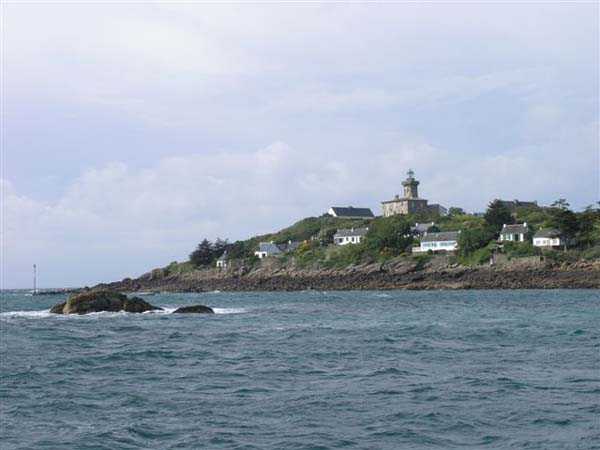
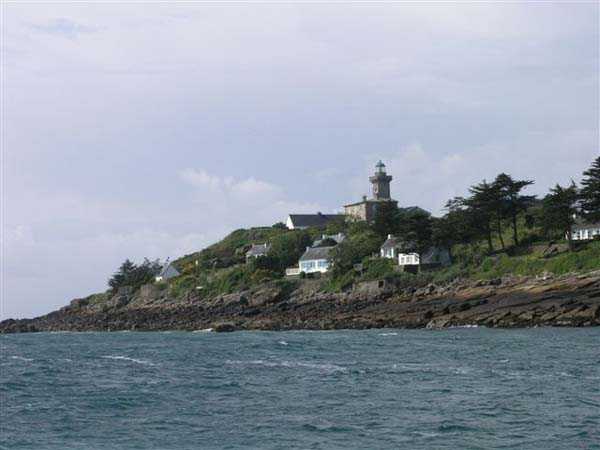
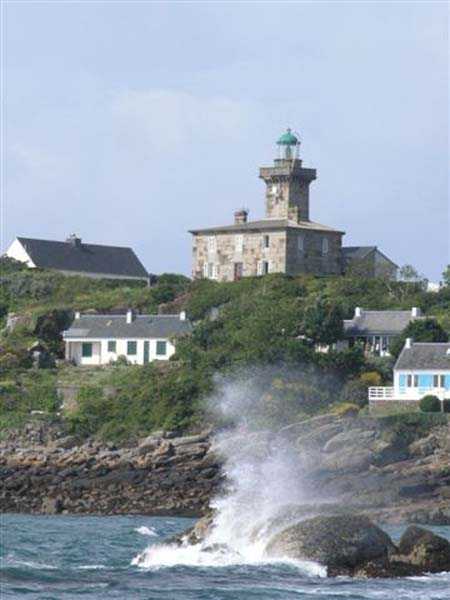
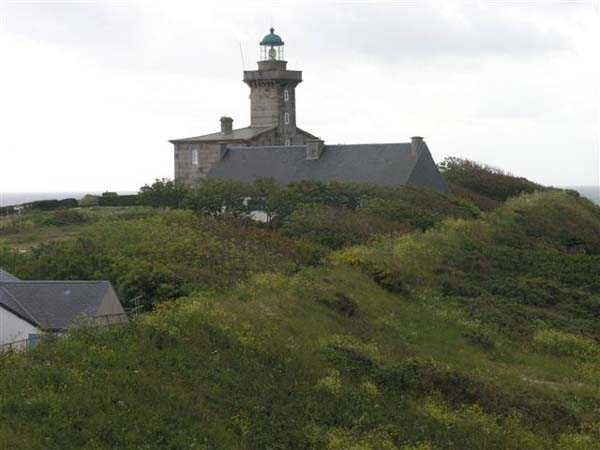
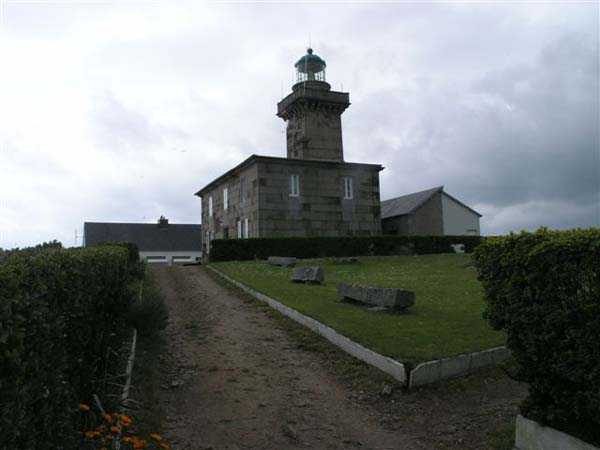

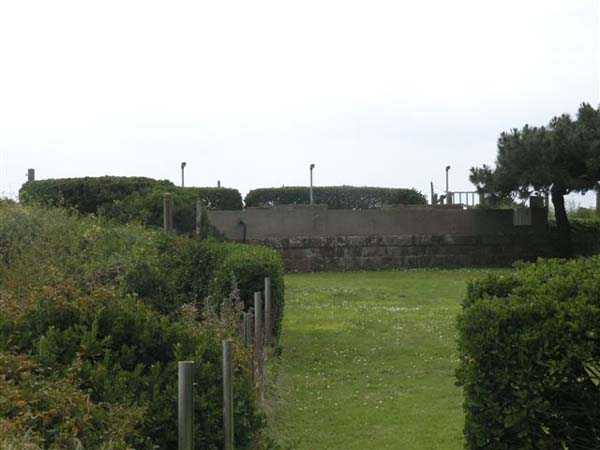

Arrondissement de Granville, archipel des Chausey. 21 m/alt. Prévue plus tardivement que le fort Chausey très proche d'elle au nord-ouest, elle consiste en un parapet aménagé autour du phare datant, lui, de 1847. On sait qu'une décision ministérielle datée du 3 juillet 1865 impose un remaniement du parapet de la batterie par adjonction de deux traverses. Cette note indique donc que la batterie existait tout de même avant que le fort voisin ne soit construit. En 1881, l'armement en place consiste en 2 canons de 30 + 4 obusiers de 22 c lisses. La même année, considérant que "les îles qui composent l'archipel Chausey sont limitées au sud par une ligne à peu près droite qui va de l'Est à l'Ouest et dont les vaisseaux peuvent s'approcher très près presque partout net y mouiller ; c'est pour défendre cette région que la batterie du Phare a été créée. Cette batterie étant susceptible d'agir à toutes distances au moyen d'obus oblongs et à petites distances à l'aide de boulets de rupture sur des navires d'une certaine puissance, la sous-commission de défense des côtes a choisi pour l'armer de canons de 16 c et 19 c spécialement affectés à ce double usage." Ainsi on prévoira 4 canons de 16 c et 2 de 19 c ; ceci étant, tout comme pour le fort voisin, il n'est pas formellement établi que l'armement fut installé. En 1888, le Conseil supérieur de la Guerre conclut à l'inutilité de conserver à Chausey des installations de défense côtière et décida leur déclassement. Aujourd'hui (05/2007), la batterie se situe en terrain interdit d'accès. Depuis l'extérieur, le parapet semble encore en bon état.
Bezirk Granville, Archipel der Chausey. 21 M/ü M. Später geplant als das Fort Chausey, das ihr im Nordwesten sehr nahe liegt, besteht sie aus einem um den Leuchtturm (dieser stammt von 1847) angelegten Parapet. Es ist bekannt, dass ein ministerieller Beschluss vom 3. Juli 1865 eine Überarbeitung des Batterieparapets durch Hinzufügung von zwei Traversen vorschreibt. Diese Notiz zeigt also, dass die Batterie dennoch existierte, bevor das benachbarte Fort gebaut wurde. 1881 besteht die vorhandene Bewaffnung aus 2 30-Kanonen + 4 glatten 22-c-Haubitzen. Im selben Jahr, in der Überlegung, dass "die Inseln, die den Chausey-Archipel bilden, im Süden durch eine etwa gerade Linie begrenzt sind, die von Ost nach West verläuft und der Schiffe fast überall sehr nahe kommen und dort ankern können; es ist zur Verteidigung dieser Region, dass die Leuchtturmbatterie geschaffen wurde. Da diese Batterie in der Lage ist, auf alle Entfernungen mittels länglicher Granaten und auf kurze Entfernung mit Durchschlagsgeschossen gegen Schiffe von einer gewissen Stärke zu wirken, hat die Unterkommission für Küstenverteidigung beschlossen, sie mit 16-c- und 19-c-Kanonen zu bewaffnen, die speziell für diese doppelte Verwendung vorgesehen sind." So sind 4 16-c- und 2 19-c-Kanonen vorgesehen; dies jedoch, genau wie beim benachbarten Fort, ist nicht offiziell festgestellt, dass die Bewaffnung installiert wurde. 1888 schloss der Oberste Kriegsrat auf die Nutzlosigkeit, in Chausey Küstenverteidigungsanlagen zu erhalten, und beschloss deren Außerdienststellung. Heute (05/2007) befindet sich die Batterie auf gesperrtem Gelände. Von außen scheint das Parapet noch in gutem Zustand.
Arrondissement Granville, archipel van de Chausey. 21 m/alt. Later gepland dan het fort Chausey dat er zeer dichtbij in het noordwesten ligt, bestaat ze uit een borstwering aangelegd rond de vuurtoren die zelf dateert van 1847. Men weet dat een ministerieel besluit van 3 juli 1865 een herziening van de borstwering van de batterij oplegt door toevoeging van twee traversen. Deze nota geeft dus aan dat de batterij desalniettemin bestond voordat het naburige fort werd gebouwd. In 1881 bestaat de aanwezige bewapening uit 2 30-kanonnen + 4 gladde 22-c-houwitsers. Hetzelfde jaar, overwegende dat "de eilanden die het Chausey-archipel vormen in het zuiden begrensd worden door een ongeveer rechte lijn die van Oost naar West loopt en waar schepen bijna overal zeer dichtbij kunnen komen en er kunnen aanleggen; het is om deze regio te verdedigen dat de Vuurtorenbatterij is gecreëerd. Deze batterij zijnde in staat om op alle afstanden te werken door middel van langwerpige granaten en op korte afstand met doorborende kogels tegen schepen van een zekere kracht, heeft de subcommissie voor kustverdediging gekozen om haar te bewapenen met 16-c- en 19-c-kanonnen speciaal bestemd voor dit dubbele gebruik." Aldus wordt voorzien in 4 16-c- en 2 19-c-kanonnen; dit zijnde, net zoals voor het naburige fort, is het niet formeel vastgesteld dat de bewapening geïnstalleerd werd. In 1888 concludeerde de Hoge Oorlogsraad tot de nutteloosheid om op Chausey kustverdedigingsinstallaties te behouden en besloot tot hun buitengebruikstelling. Vandaag (05/2007) bevindt de batterij zich op verboden terrein. Van buitenaf lijkt de borstwering nog in goede staat.
District of Granville, Chausey archipelago. 21 m above sea level. Planned later than Fort Chausey, which is very close to it to the northwest, it consists of a parapet arranged around the lighthouse, the latter dating from 1847. It is known that a ministerial decision dated July 3, 1865, requires a reworking of the battery's parapet by adding two traverses. This note therefore indicates that the battery nevertheless existed before the neighboring fort was built. In 1881, the armament in place consists of 2 30 guns + 4 smoothbore 22 c howitzers. The same year, considering that "the islands that make up the Chausey archipelago are bounded to the south by an approximately straight line running from East to West and to which ships can approach very close almost everywhere and anchor there; it is to defend this region that the Lighthouse battery was created. This battery being capable of acting at all distances by means of oblong shells and at short distances using piercing shots against ships of a certain power, the sub-commission for coastal defense chose to arm it with 16 c and 19 c guns specially assigned to this dual use." Thus, 4 16 c and 2 19 c guns are planned; this being said, just as for the neighboring fort, it is not formally established that the armament was installed. In 1888, the Superior Council of War concluded on the uselessness of retaining coastal defense installations in Chausey and decided their decommissioning. Today (05/2007), the battery is located in prohibited access terrain. From the outside, the parapet still seems in good condition.
Okres Granville, souostroví Chausey. 21 m/n.m. Plánována později než fort Chausey, který leží velmi blízko na severozápadě, sestává z parapetu upraveného kolem majáku, který sám pochází z roku 1847. Je známo, že ministerské rozhodnutí ze dne 3. července 1865 ukládá přepracování parapetu baterie přidáním dvou traverz. Tato poznámka tedy naznačuje, že baterie přesto existovala před stavbou sousedního fortu. V roce 1881 se stávající výzbroj skládá z 2 30 děl + 4 hladkých 22c houfnic. Téhož roku, s ohledem na to, že "ostrovy tvořící souostroví Chausey jsou na jihu ohraničeny přibližně přímkou vedoucí od východu na západ a ke které se mohou lodě téměř všude přiblížit velmi blízko a tam kotvit; je to k obraně tohoto regionu, že byla vytvořena majáková baterie. Tato baterie, schopná působit na všechny vzdálenosti pomocí podlouhlých granátů a na krátkou vzdálenost průbojnými střelami proti lodím určité síly, zvolila podkomise pro pobřežní obranu vyzbrojit ji 16c a 19c děly speciálně určenými pro toto dvojí použití." Je tedy plánováno 4 16c a 2 19c děla; to však, stejně jako u sousedního fortu, není formálně stanoveno, že byla výzbroj instalována. V roce 1888 Nejvyšší válečná rada dospěla k závěru o zbytečnosti zachování pobřežních obranných zařízení na Chausey a rozhodla o jejich vyřazení. Dnes (05/2007) se baterie nachází na nepřístupném terénu. Zvenčí se parapet stále jeví v dobrém stavu.
Cité dans : Zitiert in : Geciteerd in: Cited in: Citováno v: Chausey (fort), Chausey (îles)
