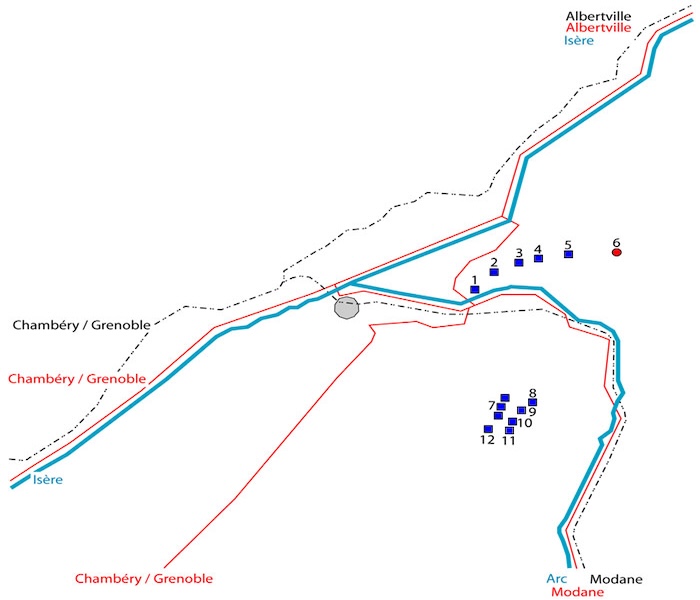
Dépt 73 (Savoie). Plus communément nommée position d'Aiton-Chamousset. Située au confluent de l'Isère, en provenance d'Albertville, et de l'Arc, débouchant de la Maurienne, (souvent évoquée comme se situant au confluent de la Maurienne et de la Tarentaise) elle verrouillait ce possible passage pour une armée italienne. Elle comprenait 3 forts, 7 batteries (+ 2 accolées sur les extérieurs du fort de Montgilbert) et 5 blockhaus. Il y eut peu de modernisations. Seuls les postes optiques des forts de Montperché et de Montgilbert seront bétonnés. En 1874, les desseins étaient cependant nettement plus vastes. On prévoyait, à hauteur de Chamousset, une position fortifiée où pourraient se replier les troupes contraintes d'évacuer la position d'Aiton. Voir Chamousset-Châteauneuf.
Dept 73 (Savoie). Häufiger als Stellung Aiton-Chamousset bezeichnet. Gelegen am Zusammenfluss der Isère, die von Albertville kommt, und des Arc, der aus dem Maurienne-Tal austritt, (oft als am Zusammenfluss von Maurienne und Tarentaise gelegen beschrieben) sperrte sie diesen möglichen Durchgang für eine italienische Armee. Sie umfasste 3 Forts, 7 Batterien (+ 2 an den Außenseiten des Forts Montgilbert angebrachte) und 5 Blockhäuser. Es gab wenige Modernisierungen. Nur die optischen Posten der Forts Montperché und Montgilbert wurden betoniert. 1874 waren die Pläne jedoch deutlich umfangreicher. Man plante auf der Höhe von Chamousset eine befestigte Stellung, in die Truppen, die die Stellung Aiton räumen mussten, sich zurückziehen könnten. Siehe Chamousset-Châteauneuf.
Dept 73 (Savoie). Vaker genoemd stelling Aiton-Chamousset. Gelegen aan de samenvloeiing van de Isère, komend van Albertville, en de Arc, uitmondend vanuit de Maurienne, (vaak beschreven als gelegen aan de samenvloeiing van de Maurienne en de Tarentaise) versperde ze deze mogelijke doorgang voor een Italiaans leger. Ze omvatte 3 forten, 7 batterijen (+ 2 tegen de buitenkanten van fort Montgilbert aangebouwde) en 5 blokhuizen. Er waren weinig moderniseringen. Alleen de optische posten van de forten Montperché en Montgilbert werden gebetonneerd. In 1874 waren de plannen echter aanzienlijk uitgebreider. Men voorzag, ter hoogte van Chamousset, een versterkte stelling waar troepen die gedwongen waren de stelling Aiton te evacueren, zich konden terugtrekken. Zie Chamousset-Châteauneuf.
Dept 73 (Savoie). More commonly called the Aiton-Chamousset position. Located at the confluence of the Isère, coming from Albertville, and the Arc, emerging from the Maurienne, (often described as being at the confluence of the Maurienne and Tarentaise) it blocked this possible passage for an Italian army. It comprised 3 forts, 7 batteries (+ 2 attached to the exteriors of fort Montgilbert) and 5 blockhouses. There were few modernizations. Only the optical posts of forts Montperché and Montgilbert were concreted. In 1874, however, the plans were considerably more extensive. It was planned, at the level of Chamousset, a fortified position where troops forced to evacuate the Aiton position could fall back. See Chamousset-Châteauneuf.
Dept 73 (Savoie). Častěji nazývána postavení Aiton-Chamousset. Ležící na soutoku Isère, přitékající od Albertville, a Arc, vystupujícího z Maurienne, (často popisována jako ležící na soutoku Maurienne a Tarentaise) blokovala tento možný průchod pro italskou armádu. Zahrnovala 3 tvrze, 7 baterií (+ 2 přilehlé k vnějším stranám tvrze Montgilbert) a 5 bunkrů. Modernizací bylo málo. Pouze optické stanice tvrzí Montperché a Montgilbert byly betonovány. V roce 1874 však byly plány výrazně rozsáhlejší. Plánovalo se, v úrovni Chamousset, opevněné postavení, kam by se mohly stáhnout jednotky nucené evakuovat postavení Aiton. Viz Chamousset-Châteauneuf.
Cité dans : Zitiert in : Geciteerd in: Cited in: Citováno v: Crépas (blockhaus et coupure du)
