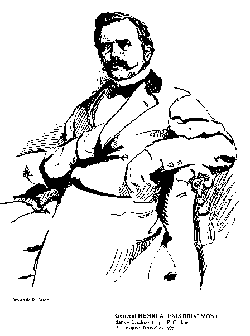
Henri Alexis Brialmont, Général belge né à Venlo dans le Limbourg le 25 mai 1821 et décédé à Saint-Josse-ten-Noode en 1903. Il fortifia Anvers (1859), Bucarest (1877), Liège et Namur (1888). Ça c'est ce qu'en dit le dictionnaire. Mais c'est assez peu pour un bonhomme comme Brialmont qui ne pâlirait pas à côté de personnages comme Sébastien Le Prestre de Vauban (1633-1707), Simon Stevin (1548-1620) ou Menno van Coehoorn (1641-1704) dans leurs pays respectifs. Tous furent de grands architectes militaires.
Au cours de sa carrière militaire de plus de 50 ans il a publié plus de cent ouvrages concernant les fortifications à l'époque où elles étaient en pleine mutation tant du point de vue des matériaux de construction, passant des talus de terre par la pierre et la brique au béton simple et non armé, que du point de vue de l'artillerie, passant des canons lisses à chargement par la bouche aux canons rayés à chargement par la culasse. Bon nombre de ses ouvrages sont consultables au Musée Royal Militaire dans le Parc du Cinquantenaire à Bruxelles, et à la bibliothèque de la Défense Nationale rue Hobbema 8 également à Bruxelles.
Ses nombreux voyages partout en Europe et dans le monde lui permettront d'avoir une excellente vue de synthèse sur tous les sujets militaires de son époque. Ses prises de position et ses choix politiques ne lui vaudront pas toujours que des amis et il connaîtra plusieurs périodes de disgrâces. À chaque fois cependant, il s'avèrera, a posteriori, qu'il avait eu raison et il sera rappelé quand il n'obtiendra pas une promotion.
Henri Alexis Brialmont, belgischer General, geboren in Venlo in Limburg am 25. Mai 1821 und gestorben in Saint-Josse-ten-Noode im Jahr 1903. Er befestigte Antwerpen (1859), Bukarest (1877), Lüttich und Namur (1888). Das ist es, was das Lexikon darüber sagt. Aber es ist ziemlich wenig für einen Mann wie Brialmont, der neben Persönlichkeiten wie Sébastien Le Prestre de Vauban (1633-1707), Simon Stevin (1548-1620) oder Menno van Coehoorn (1641-1704) in ihren jeweiligen Ländern nicht verblassen würde. Alle waren große Militärarchitekten.
Im Laufe seiner mehr als 50-jährigen militärischen Laufbahn veröffentlichte er über hundert Werke über Befestigungen zu einer Zeit, als diese sich im vollen Wandel befanden, sowohl was die Baumaterialien betraf, die von Erdwällen über Stein und Ziegel zu einfachem, unbewehrtem Beton übergingen, als auch was die Artillerie betraf, die von glatten, vom Lauf zu ladenden Kanonen zu gezogenen, von der Kammer zu ladenden Kanonen überging. Viele seiner Werke sind im Königlichen Militärmuseum im Park des Cinquantenaire in Brüssel und in der Bibliothek der Nationalen Verteidigung, Hobbemastraat 8, ebenfalls in Brüssel, einsehbar.
Seine zahlreichen Reisen in ganz Europa und in der Welt ermöglichten ihm einen ausgezeichneten synthetischen Überblick über alle militärischen Themen seiner Zeit. Seine Standpunkte und politischen Entscheidungen brachten ihm nicht immer nur Freunde ein, und er erlebte mehrere Perioden der Ungnade. Jedes Mal jedoch würde sich im Nachhinein erweisen, dass er Recht gehabt hatte, und er würde zurückgerufen werden, wenn er keine Beförderung erhielt.
Henri Alexis Brialmont, Belgisch generaal geboren te Venlo in Limburg op 25 mei 1821 en overleden te Sint-Joost-ten-Node in 1903. Hij versterkte Antwerpen (1859), Boekarest (1877), Luik en Namen (1888). Dat is wat het woordenboek erover zegt. Maar het is vrij weinig voor een kerel als Brialmont, die niet zou verbleken naast persoonlijkheden als Sébastien Le Prestre de Vauban (1633-1707), Simon Stevin (1548-1620) of Menno van Coehoorn (1641-1704) in hun respectievelijke landen. Allen waren grote militaire architecten.
Gedurende zijn militaire loopbaan van meer dan 50 jaar publiceerde hij meer dan honderd werken over versterkingen in een tijd waarin deze in volle verandering waren, zowel wat de bouwmaterialen betreft, die van aardewallen via steen en baksteen naar eenvoudig, niet-gewapend beton overgingen, als wat de artillerie betreft, die van gladde, via de mond te laden kanonnen naar getrokken, via de kamer te laden kanonnen overging. Vele van zijn werken zijn raadpleegbaar in het Koninklijk Museum van het Leger in het Jubelpark te Brussel, en in de bibliotheek van de Nationale Defensie, Hobbemastraat 8, eveneens te Brussel.
Zijn talrijke reizen over heel Europa en de wereld stelden hem in staat een uitstekend synthetisch overzicht te hebben over alle militaire onderwerpen van zijn tijd. Zijn standpunten en politieke keuzes leverden hem niet altijd alleen maar vrienden op en hij kende verschillende periodes van ongenade. Elke keer echter zou achteraf blijken dat hij gelijk had gehad en hij zou worden teruggeroepen wanneer hij geen promotie zou verkrijgen.
Henri Alexis Brialmont, Belgian general born in Venlo in the Dutch province of Limburg on 25 May 1821 and deceased in Saint-Josse-ten-Noode in 1903. He was responsible for fortifying Antwerp (1859), Bucharest (1877), Liège and Namur (1888). That is essentially what dictionary entries state about him. But it is rather insufficient coverage for a figure of Brialmont's stature who would not pale in comparison to such renowned personalities as Sébastien Le Prestre de Vauban (1633-1707), Simon Stevin (1548-1620) or Menno van Coehoorn (1641-1704) within their respective national contexts. All of these men were exceptional military architects of their eras.
Throughout his distinguished military career spanning more than 50 years, he published over one hundred scholarly works concerning fortifications during a period when they were undergoing profound transformation both from the perspective of construction materials – transitioning from earth ramparts through stone and brick masonry to simple, unreinforced concrete – and from the standpoint of artillery development – evolving from smoothbore muzzle-loading cannons to rifled breech-loading cannons. A substantial number of his technical writings and treatises remain available for consultation at the Royal Military Museum located within Brussels' Cinquantenaire Park, as well as at the National Defence Library situated at Hobbemastraat 8, also in Brussels.
His extensive travels throughout Europe and across the world afforded him an exceptionally comprehensive overview and enabled him to develop a remarkable synthetic understanding of all military matters pertinent to his epoch. His firmly held positions and political stances did not always earn him exclusively friends, and he experienced several periods of official disfavor. Each time however, subsequent events would ultimately demonstrate that his judgments had been correct, and he would be recalled to service even in instances where deserved promotions had been denied to him.
Henri Alexis Brialmont, belgický generál narozený ve Venlo v nizozemském Limburgu 25. května 1821 a zesnulý v Saint-Josse-ten-Noode roku 1903. Proslul jako tvůrce fortifikací Antverp (1859), Bukurešti (1877), Lutychu a Namuru (1888). Tolik hovoří encyklopedická hesla. Avšak to je poměrně skromné ocenění pro muže formátu Brialmonta, jenž by se svým významem nemusel stydět vedle takových postav jako Sébastien Le Prestre de Vauban (1633-1707), Simon Stevin (1548-1620) či Menno van Coehoorn (1641-1704) ve svých vlastích zemích. Všichni tito muži náleželi mezi nejvýznamnější vojenské architekty své doby.
Během své více než padesátileté vojenské kariéry publikoval přes stovku odborných prací týkajících se pevnostního stavitelství v éře, kdy opevňovací technika procházela zásadní proměnou – a to jak po stránce stavebních materiálů (přechod od zemních valů přes kamenné a cihlové konstrukce k prostému nevyztuženému betonu), tak po stránce dělostřelecké výzbroje (přechod od hladkých předovek k drážkovým zadovkám). Mnoho jeho odborných spisů a studií je dodnes přístupných badatelům v Královském vojenském muzeu v bruselském parku Cinquantenaire a rovněž v knihovně Národní obrany na adrese Hobbemastraat 8 v Bruselu.
Jeho četné studijní cesty po Evropě i zámoří mu poskytly mimořádně široký rozhled a umožnily mu vytvořit komplexní syntézu vojenských poznatků své epochy. Jeho pevné názorové postoje a politická stanoviska mu nezískávaly vždy pouze přátele a několikrát upadl v nemilost. Pokaždé se však nakonec ukázalo, že jeho úsudek byl správný, a byl povoláván zpět do služby i v případech, kdy mu byla odepřena zasloužená povýšení.
Dates marquantes
| 1838 | Entrée à l'École Royale Militaire |
| 1841 | Nommé Sous-Lieutenant du régiment du Génie à Liège |
| 1847 | Nommé Lieutenant du Génie et attaché au cabinet du Général Chazal, ministre de la guerre |
| 1848 | Il publie un pamphlet intitulé "Éloge de la guerre" dans lequel il met en avant les avantages d'une armée forte pour la Belgique |
| 1851 | Publication de l'ouvrage "Considérations politiques et militaires sur la Belgique" |
| 1854 | Pendant la guerre de Crimée et l'occupation de Sébastopol, il demande sa mutation vers l'armée française. Mutation refusée |
| 1855 | Promu capitaine d'état-major, il parcourt l'Allemagne pour étudier les forts polygonaux |
| 1856 | Publication de "L'Histoire du Duc de Wellington" |
| 1857 | Il se rend en Angleterre avec le but de s'engager dans le corps expéditionnaire visant à mater la révolte en Inde. Demande refusée |
| 1858 | Réaffecté au cabinet du ministre de la guerre, le capitaine Chazal. Le roi Léopold demande des projets de fortification de la ville d'Anvers. Celui de Brialmont est retenu |
| 1859 | La commission ratifie le projet Brialmont. Le 19 mai, il épouse Justa de Potter. Début de la construction des forts 1 à 8 et Merksem |
| 1860 | Il est promu Major d'État-Major |
| 1863 | Publication de "Étude sur la défense des États et sur la fortification" |
| 1868 | Il est nommé directeur des opérations militaires au Ministère de la Guerre et est chargé d'enquêter sur la mobilisation et la concentration des armées |
| 1870 | Il est le chef d'état-major de l'armée à Anvers pendant la durée de la guerre |
| 1874 | Il est promu général-major et nommé à la direction des fortifications à Anvers |
| 1875 | Décès de son épouse âgée de 41 ans |
| 1878 | Loi pour la construction des forts de Walem et de Lier |
| 1882 | Publication de "Situation Militaire de Belgique - Travaux de défense de la Meuse" dont est extraite la citation suivante : "L'Allemagne ne violera donc pas le territoire neutre de la Suisse pour attaquer la France, mais elle violera certainement le territoire neutre du Grand-duché de Luxembourg et vraisemblablement le territoire neutre de la Belgique, à moins que ce dernier pays n'augmente de beaucoup ses moyens de défense… L'annexion de la Lorraine à l'Allemagne a augmenté l'importance stratégique de la ligne de la Meuse. Si l'Allemagne attaque la France, elle a un intérêt immense à passer la Meuse à Liège ou à Namur pour envahir la France par le Nord… La première guerre entre la France et l'Allemagne démontrera l'impérieuse nécessité des travaux de la Meuse." |
| 1882 | Il inspecte le système défensif de Roumanie à la demande du Roi Roumain et se fait mettre à pied suite à une plainte de l'Autriche |
| 1884 | Rappelé, il est nommé à l'inspection générale du Génie et des Fortifications |
| 1887 | Décision du 14 juin de fortifier Liège et Namur |
| 1891 | Les forts de Liège et de Namur sont prêts mais Brialmont est pensionné pour dépassement de budget |
| 1892 | Il visite les lignes de défense de Constantinople |
| 1893 | Il est élu au Parlement |
Bedeutende Daten
| 1838 | Eintritt in die Königliche Militärschule |
| 1841 | Ernennung zum Sous-Lieutenant des Genieregiments in Lüttich |
| 1847 | Ernennung zum Lieutenant der Genietruppe und Attaché im Kabinett von General Chazal, Kriegsminister |
| 1848 | Er veröffentlicht eine Schrift mit dem Titel "Lob des Krieges", in der er die Vorteile einer starken Armee für Belgien hervorhebt |
| 1851 | Veröffentlichung des Werks "Politische und militärische Betrachtungen über Belgien" |
| 1854 | Während des Krimkriegs und der Besetzung von Sewastopol beantragt er seine Versetzung zur französischen Armee. Versetzung abgelehnt |
| 1855 | Befördert zum Hauptmann im Generalstab, bereist er Deutschland, um polygonale Festungen zu studieren |
| 1856 | Veröffentlichung von "Die Geschichte des Herzogs von Wellington" |
| 1857 | Er reist nach England mit dem Ziel, sich dem Expeditionskorps anzuschließen, das den Aufstand in Indien niederschlagen soll. Antrag abgelehnt |
| 1858 | Wiedereingesetzt im Kabinett des Kriegsministers, Hauptmann Chazal. König Leopold fordert Projekte zur Befestigung der Stadt Antwerpen. Dasjenige von Brialmont wird angenommen |
| 1859 | Die Kommission ratifiziert das Brialmont-Projekt. Am 19. Mai heiratet er Justa de Potter. Baubeginn der Forts 1 bis 8 und Merksem |
| 1860 | Er wird zum Major im Generalstab befördert |
| 1863 | Veröffentlichung von "Studie über die Verteidigung der Staaten und über die Befestigung" |
| 1868 | Er wird zum Direktor der Militäroperationen im Kriegsministerium ernannt und mit der Untersuchung der Mobilmachung und Konzentration der Armeen beauftragt |
| 1870 | Er ist während des gesamten Krieges Generalstabschef der Armee in Antwerpen |
| 1874 | Er wird zum Generalmajor befördert und zum Leiter der Festungsanlagen in Antwerpen ernannt |
| 1875 | Tod seiner Ehefrau im Alter von 41 Jahren |
| 1878 | Gesetz für den Bau der Forts von Walem und Lier |
| 1882 | Veröffentlichung von "Militärische Lage Belgiens - Verteidigungswerke an der Maas", aus dem folgendes Zitat entnommen ist: "Deutschland wird also nicht das neutrale Gebiet der Schweiz verletzen, um Frankreich anzugreifen, aber es wird sicherlich das neutrale Gebiet des Großherzogtums Luxemburg und wahrscheinlich das neutrale Gebiet Belgiens verletzen, es sei denn, dieses letzte Land erhöht seine Verteidigungsmittel erheblich… Die Annexion Lothringens durch Deutschland hat die strategische Bedeutung der Maaslinie erhöht. Wenn Deutschland Frankreich angreift, hat es ein immenses Interesse daran, die Maas bei Lüttich oder Namur zu überqueren, um Frankreich von Norden her zu überfallen… Der erste Krieg zwischen Frankreich und Deutschland wird die zwingende Notwendigkeit der Maasarbeiten demonstrieren." |
| 1882 | Er inspiziert auf Anfrage des rumänischen Königs das Verteidigungssystem Rumäniens und wird aufgrund einer Beschwerde Österreichs suspendiert |
| 1884 | Zurückberufen, wird er zur allgemeinen Inspektion der Genietruppe und der Festungen ernannt |
| 1887 | Entscheidung vom 14. Juni zur Befestigung von Lüttich und Namur |
| 1891 | Die Forts von Lüttich und Namur sind fertig, aber Brialmont wird aufgrund von Budgetüberschreitung pensioniert |
| 1892 | Er besichtigt die Verteidigungslinien von Konstantinopel |
| 1893 | Er wird ins Parlament gewählt |
Markante data
| 1838 | Toegang tot de Koninklijke Militaire School |
| 1841 | Benoemd tot Onderluitenant van het genieregiment in Luik |
| 1847 | Benoemd tot Luitenant van de Genie en attaché in het kabinet van Generaal Chazal, minister van oorlog |
| 1848 | Hij publiceert een pamflet getiteld "Lof van de oorlog" waarin hij de voordelen van een sterk leger voor België benadrukt |
| 1851 | Publicatie van het werk "Politieke en militaire overwegingen over België" |
| 1854 | Tijdens de Krimoorlog en de bezetting van Sebastopol vraagt hij zijn overplaatsing naar het Franse leger. Overplaatsing geweigerd |
| 1855 | Bevorderd tot kapitein van de generale staf, reist hij door Duitsland om polygonale forten te bestuderen |
| 1856 | Publicatie van "De Geschiedenis van de Hertog van Wellington" |
| 1857 | Hij reist naar Engeland met het doel zich aan te sluiten bij het expeditiekorps dat de opstand in India moet onderdrukken. Aanvraag geweigerd |
| 1858 | Herplaatst in het kabinet van de minister van oorlog, kapitein Chazal. Koning Leopold vraagt projecten voor de versterking van de stad Antwerpen. Dat van Brialmont wordt weerhouden |
| 1859 | De commissie bekrachtigt het Brialmont-project. Op 19 mei trouwt hij met Justa de Potter. Start van de bouw van forten 1 tot 8 en Merksem |
| 1860 | Hij wordt bevorderd tot Majoor van de Generale Staf |
| 1863 | Publicatie van "Studie over de verdediging van Staten en over de vestingbouw" |
| 1868 | Hij wordt benoemd tot directeur van de militaire operaties op het Ministerie van Oorlog en krijgt de opdracht onderzoek te doen naar de mobilisatie en concentratie van de legers |
| 1870 | Hij is de stafchef van het leger in Antwerpen gedurende de hele oorlog |
| 1874 | Hij wordt bevorderd tot generaal-majoor en benoemd tot directeur van de vestingwerken in Antwerpen |
| 1875 | Overlijden van zijn echtgenote op 41-jarige leeftijd |
| 1878 | Wet voor de bouw van de forten van Walem en Lier |
| 1882 | Publicatie van "Militaire Situatie van België - Verdedigingswerken van de Maas" waaruit het volgende citaat is genomen: "Duitsland zal dus niet het neutrale grondgebied van Zwitserland schenden om Frankrijk aan te vallen, maar het zal zeker het neutrale grondgebied van het Groothertogdom Luxemburg schenden en waarschijnlijk het neutrale grondgebied van België, tenzij dit laatste land zijn verdedigingsmiddelen sterk uitbreidt… De annexatie van Lotharingen door Duitsland heeft het strategisch belang van de Maaslinie vergroot. Als Duitsland Frankrijk aanvalt, heeft het een immens belang om de Maas over te steken bij Luik of Namen om Frankrijk vanuit het Noorden binnen te vallen… De eerste oorlog tussen Frankrijk en Duitsland zal de dwingende noodzaak van de Maaswerken aantonen." |
| 1882 | Hij inspecteert op verzoek van de Roemeense koning het verdedigingssysteem van Roemenië en wordt na een klacht van Oostenrijk geschorst |
| 1884 | Teruggeroepen, wordt hij benoemd tot de algemene inspectie van de Genie en de Vestingen |
| 1887 | Beslissing van 14 juni om Luik en Namen te versterken |
| 1891 | De forten van Luik en Namen zijn klaar maar Brialmont wordt op pensioen gesteld wegens budgetoverschrijding |
| 1892 | Hij bezoekt de verdedigingslinies van Constantinopel |
| 1893 | Hij wordt verkozen in het Parlement |
Significant Dates
| 1838 | Entry into the Royal Military School |
| 1841 | Appointed Second Lieutenant of the Engineer Regiment in Liège |
| 1847 | Appointed Lieutenant of Engineers and attached to the cabinet of General Chazal, Minister of War |
| 1848 | He publishes a pamphlet titled "In Praise of War" in which he emphasizes the advantages of a strong army for Belgium |
| 1851 | Publication of the work "Political and Military Considerations on Belgium" |
| 1854 | During the Crimean War and the occupation of Sebastopol, he requests his transfer to the French army. Transfer refused |
| 1855 | Promoted to Captain of the General Staff, he travels through Germany to study polygonal forts |
| 1856 | Publication of "The History of the Duke of Wellington" |
| 1857 | He travels to England with the aim of joining the expeditionary corps intended to quell the rebellion in India. Request refused |
| 1858 | Reassigned to the cabinet of the Minister of War, Captain Chazal. King Leopold requests projects for the fortification of the city of Antwerp. Brialmont's project is selected |
| 1859 | The commission ratifies the Brialmont project. On 19 May, he marries Justa de Potter. Beginning of construction of forts 1 to 8 and Merksem |
| 1860 | He is promoted to Major of the General Staff |
| 1863 | Publication of "Study on the Defense of States and on Fortification" |
| 1868 | He is appointed Director of Military Operations at the Ministry of War and is tasked with investigating mobilization and concentration of armies |
| 1870 | He is the Chief of Staff of the army in Antwerp throughout the duration of the war |
| 1874 | He is promoted to Major General and appointed to the direction of fortifications in Antwerp |
| 1875 | Death of his wife at the age of 41 |
| 1878 | Law for the construction of the forts of Walem and Lier |
| 1882 | Publication of "Military Situation of Belgium - Defense Works of the Meuse" from which the following quote is extracted: "Germany will therefore not violate the neutral territory of Switzerland to attack France, but it will certainly violate the neutral territory of the Grand Duchy of Luxembourg and probably the neutral territory of Belgium, unless the latter country greatly increases its means of defense… The annexation of Lorraine by Germany has increased the strategic importance of the Meuse line. If Germany attacks France, it has an immense interest in crossing the Meuse at Liège or Namur to invade France from the North… The first war between France and Germany will demonstrate the imperative necessity of the Meuse works." |
| 1882 | He inspects the defensive system of Romania at the request of the Romanian King and is suspended following a complaint from Austria |
| 1884 | Recalled, he is appointed to the general inspection of Engineers and Fortifications |
| 1887 | Decision of 14 June to fortify Liège and Namur |
| 1891 | The forts of Liège and Namur are ready but Brialmont is pensioned off due to budget overrun |
| 1892 | He visits the defense lines of Constantinople |
| 1893 | He is elected to Parliament |
Významná data
| 1838 | Vstup na Královskou vojenskou školu |
| 1841 | Jmenovaný podporučíkem ženijního pluku v Lutychu |
| 1847 | Jmenovaný poručíkem ženistů a přidělen do kabinetu generála Chazala, ministra války |
| 1848 | Publikuje brožuru s názvem "Chvála války", ve které zdůrazňuje výhody silné armády pro Belgii |
| 1851 | Publikace díla "Politické a vojenské úvahy o Belgii" |
| 1854 | Během krymské války a okupace Sevastopolu žádá o převelení do francouzské armády. Převelení zamítnuto |
| 1855 | Povýšen na kapitána generálního štábu, cestuje po Německu, aby studoval polygonální pevnosti |
| 1856 | Publikace "Historie vévody z Wellingtonu" |
| 1857 | Odjíždí do Anglie s cílem připojit se k expedičnímu sboru zamýšlenému potlačit povstání v Indii. Žádost zamítnuta |
| 1858 | Přeřazen zpět do kabinetu ministra války, kapitána Chazala. Král Leopold žádá o projekty na opevnění města Antverpy. Brialmontův projekt je vybrán |
| 1859 | Komise schvaluje Brialmontův projekt. Dne 19. května se žení s Justou de Potter. Začátek výstavby pevností 1 až 8 a Merksemu |
| 1860 | Povýšen na majora generálního štábu |
| 1863 | Publikace "Studie o obraně států a o opevnění" |
| 1868 | Jmenován ředitelem vojenských operací na ministerstvu války a pověřen vyšetřováním mobilizace a koncentrace armád |
| 1870 | Je náčelníkem štábu armády v Antverpách po celou dobu války |
| 1874 | Povýšen na generálmajora a jmenován do vedení opevnění v Antverpách |
| 1875 | Úmrtí jeho manželky ve věku 41 let |
| 1878 | Zákon pro výstavbu pevností Walem a Lier |
| 1882 | Publikace "Vojenská situace Belgie - Obranná díla na Máze", z níž je vyňat následující citát: "Německo tedy nenapadne neutrální území Švýcarska, aby zaútočilo na Francii, ale určitě napadne neutrální území Velkovévodství Lucemburského a pravděpodobně neutrální území Belgie, pokud tato země nezvýší značně své obranné prostředky… Anexe Lotrinska Německem zvýšila strategický význam linie na Máze. Pokud Německo zaútočí na Francii, má obrovský zájem překročit Mázu u Lutychu nebo Namuru, aby napadlo Francii ze severu… První válka mezi Francií a Německem prokáže naléhavou nezbytnost prací na Máze." |
| 1882 | Na žádost rumunského krále provádí inspekci obranného systému Rumunska a je suspendován na základě stížnosti Rakouska |
| 1884 | Povolán zpět, je jmenován do generální inspekce ženistů a opevnění |
| 1887 | Rozhodnutí ze 14. června opevnit Lutych a Namur |
| 1891 | Pevnosti Lutychu a Namuru jsou hotovy, ale Brialmont je penzionován kvůli překročení rozpočtu |
| 1892 | Navštěvuje obranné linie Konstantinopole |
| 1893 | Je zvolen do parlamentu |
Cité dans : Zitiert in : Geciteerd in: Cited in: Citováno v: Lier (fort de), Liezele (fort de), Sint-Katelijne-Waver (fort de), Oelegem (fort d'), Primsenhof (batterie de), Sint-Filips (fort), Kessel (fort de), Haasdonck (fort de), Koningshooikt (fort de)