Bougie[b319][36.751450 N, 5.055771 E]

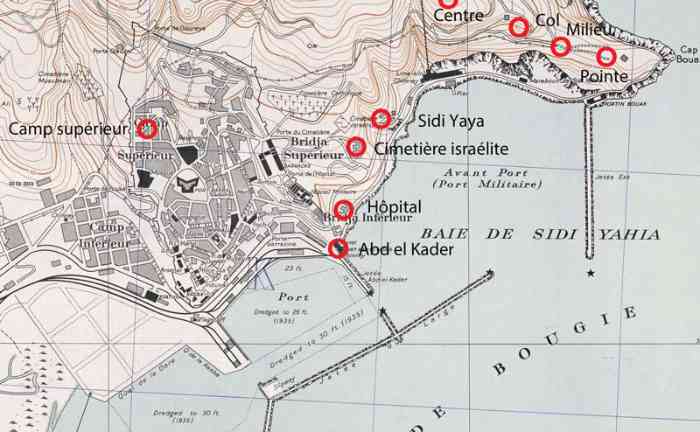
La zone fortifiée du golfe de Bougie, conçue dans le cadre du système Séré de Rivières entre 1874 et 1914, constitue un dispositif cohérent destiné à assurer la défense avancée du port et du littoral algérien. Répartis de manière méthodique, les ouvrages tels que les batteries de Bouack, le fort Abd el Kader, les positions de Cap Carbon ou encore les emplacements intermédiaires du Centre, du Milieu et de l’Hôpital forment un réseau de feux couvrant les approches maritimes et terrestres. L’ensemble repose sur le contrôle des points hauts, la surveillance continue des passes et la complémentarité entre batteries côtières, postes optiques et défenses anti-sous-marines. Cette organisation illustre l’adaptation du système Séré de Rivières aux impératifs coloniaux et aux conditions géographiques du golfe.

Der befestigte Raum des Golfs von Bougie, entwickelt im Rahmen des Systems Séré de Rivières zwischen 1874 und 1914, bildet ein abgestimmtes Verteidigungsnetz zur Sicherung des Hafens und der algerischen Küste. Die systematisch verteilten Anlagen – darunter die Batterien von Bouack, das Fort Abd el Kader, die Stellungen von Cap Carbon sowie die Zwischenpositionen Centre, Milieu und Hôpital – gewährleisten überlappende Feuerfelder zur Kontrolle der See- und Landzugänge. Das Konzept beruht auf der Beherrschung der Höhenpunkte, permanenter Beobachtung der Zugänge und der Ergänzung zwischen Küstenbatterien, optischen Posten und U-Boot-Abwehrstellungen. Dieser Aufbau zeigt die Anpassung des Séré-de-Rivières-Systems an koloniale Anforderungen und die geografischen Bedingungen des Golfs.

Het versterkte gebied van de Golf van Bougie, ontwikkeld binnen het Séré de Rivières-stelsel tussen 1874 en 1914, vormt een geïntegreerd verdedigingscomplex voor de beveiliging van de haven en de Algerijnse kust. De zorgvuldig geplaatste werken – waaronder de batterijen van Bouack, het fort Abd el Kader, de posities van Cap Carbon en de tussenstellingen Centre, Milieu en Hôpital – creëren overlappende vuurzones die zowel maritieme als landtoegangen beheersen. De verdediging steunt op controle van hoogtes, voortdurende observatie van doorgangen en de samenwerking tussen kustbatterijen, optische posten en onderzeebootbestrijdingspunten. Deze opzet weerspiegelt de aanpassing van het Séré-de-Rivières-systeem aan koloniale omstandigheden en de specifieke geografie van de golf.

The fortified zone of the Gulf of Bougie, developed within the Séré de Rivières system between 1874 and 1914, forms a coordinated defensive network intended to secure the port and the Algerian coastline. Its installations—including the Bouack batteries, Fort Abd el Kader, the Cap Carbon positions, and the intermediate sites at Centre, Milieu, and Hôpital—provide overlapping fields of fire covering both maritime and land approaches. The layout relies on high-ground dominance, continuous surveillance of access routes, and the complementarity of coastal batteries, optical signal posts, and anti-submarine defences. This configuration illustrates how the Séré de Rivières system was adapted to colonial requirements and to the particular geographical constraints of the gulf.

Opevněná oblast v zálivu Bougie, vybudovaná v rámci systému Séré de Rivières v letech 1874–1914, představuje sladěnou obrannou soustavu určenou k ochraně přístavu a alžírského pobřeží. Rozmístění objektů – baterií Bouack, pevnosti Abd el Kader, stanovišť na Cap Carbon a mezilehlých pozic Centre, Milieu a Hôpital – vytváří překrývající se palebná pole kontrolující námořní i pozemní přístupy. Koncepce je založena na ovládnutí vyvýšenin, trvalém sledování vstupních směrů a součinnosti pobřežních baterií, optických stanovišť a prostředků proti ponorkám. Toto uspořádání dokládá přizpůsobení systému Séré de Rivières koloniálním požadavkům i geografickým podmínkám zálivu.

Cité dans : Zitiert in : Geciteerd in: Cited in: Citováno v: Dellys (poste de défense contre les sous-marins de), Fort Gênois (batterie du), Beni-Falkai (poste de défense contre les sous-marins de)